
Pad is a multiplayer AI workspace where teams collaborate with AI across shared conversations, documents, and connected tools. As Pad added more MCP integrations, co-founder Dillon Carter wanted a simple way for its agents to retrieve real company assets inside the same workflow.
"We wanted the ability to pull real brand logos inside of Pad, and Context.dev didn't disappoint. From creating the account to pulling logos via the MCP took at most 10 minutes, which is really saying something."
The use case
Pad is consistently adding MCPs to give its AI workspace access to the tools and data a team already uses. Brand assets were a natural part of that system. When a user mentions a company, the agent should be able to find the right logo without sending someone out to search for files or maintain an asset library by hand.
Dillon needed an easy way to pull those assets for each company quickly. Context.dev offered that brand layer through the same MCP pattern Pad already uses for new integrations.
How Pad found Context.dev
Dillon found Context.dev on X. The product matched Pad's architecture immediately: instead of building a separate logo retrieval pipeline, the team could connect the MCP directly to what it had already built.
That made the evaluation practical. Pad could test Context.dev inside a real agent conversation and see whether a plain-language request produced a usable brand asset.
From account creation to a real logo in under 10 minutes
The full setup, from creating the Context.dev account to pulling a logo through MCP, took no more than 10 minutes.
The supplied capture shows the result inside Pad. Dillon asks Padric to pull the brand logos for resend.com. The agent runs Context.dev's brand tools and returns the Resend wordmark directly in the conversation.
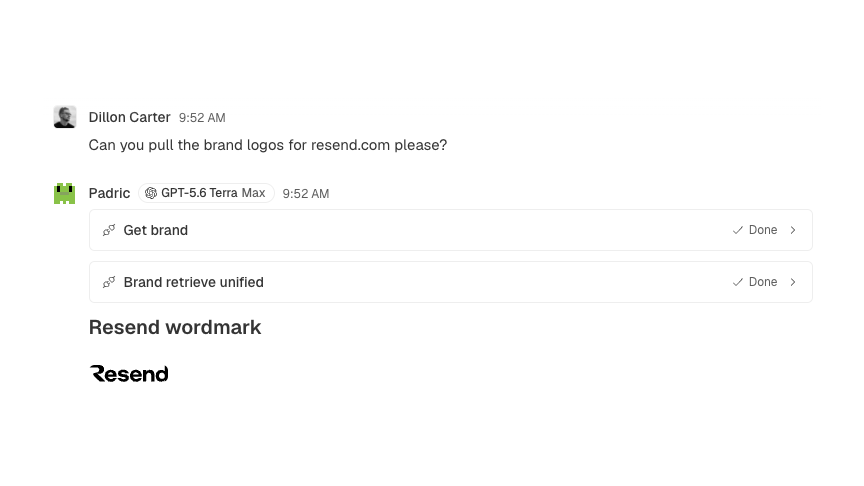
There is no separate asset search or handoff. The request, retrieval, and result all stay in the workspace where the logo is needed.
Why MCP fits Pad
"Because Context.dev offers a straightforward MCP, we're able to use it directly in what we've built at Pad. As we add new integrations, which are usually MCPs, we reach for Context.dev to grab the assets we need."
That direct fit matters as Pad expands. Brand retrieval does not have to become a one-off integration with its own interface and maintenance burden. It remains a reusable capability that Pad's agents can call whenever a company asset is part of the task.
Key benefits
- Working in under 10 minutes: Pad went from account creation to its first logo retrieval through MCP in a single short setup.
- Real brand assets inside the conversation: users can ask for a company logo and get the result where they are already working.
- Native to Pad's integration model: Context.dev fits the MCP architecture Pad uses as it connects more tools.
- A repeatable brand layer: the team can reach for the same integration whenever a new workflow needs company assets.
The outcome
Context.dev gives Pad a straightforward way to bring real company logos into its multiplayer AI workspace. The first end-to-end retrieval took less than 10 minutes to set up, and the same MCP is now available whenever Pad adds an integration or workflow that needs brand assets.
Building an AI workspace that needs real company assets on demand? Context.dev lets agents retrieve logos and brand context through MCP, so the result can appear directly inside the workflow.
If you need your team and its AI tools working together from the same context, then try Pad.