



We caught up with Mark, cofounder of Polished.ad (YC W24), after the team integrated Context.dev into the brand setup layer behind its AI ad creation product. Polished.ad helps teams generate finished static or video ads in minutes, then refine them in plain English until the creative matches the idea they had in mind.
Mark found Context.dev through our YC batch entry and compared it against the brand-data tools Polished had already seen:
"Found out about Context.dev through their YC batch entry (congrats) and found the API responses a lot more up-to-date and reliable for real sites vs Brandfetch." - Mark, Cofounder @ Polished.ad
What is Polished.ad?
Polished.ad, a Y Combinator W24 company, is an AI ad agent for teams that want finished creative without stitching together a dozen separate tools. A user can start from a prompt, describe a product and audience, and let Polished brainstorm angles, generate visuals, write copy, compose layouts, and produce a finished ad.
The product supports both static and video ads, plus iteration in natural language. Users can ask for a new direction, translate an ad, reformat it for another platform, add voiceover and music, or remix an existing ad style for their own brand.
That promise depends on brand context. If Polished is going to create ads that are ready for Meta, TikTok, YouTube, LinkedIn, or Instagram, the system has to know the customer's logo, colors, fonts, brand voice, product story, and visual constraints before generation starts.
The use case
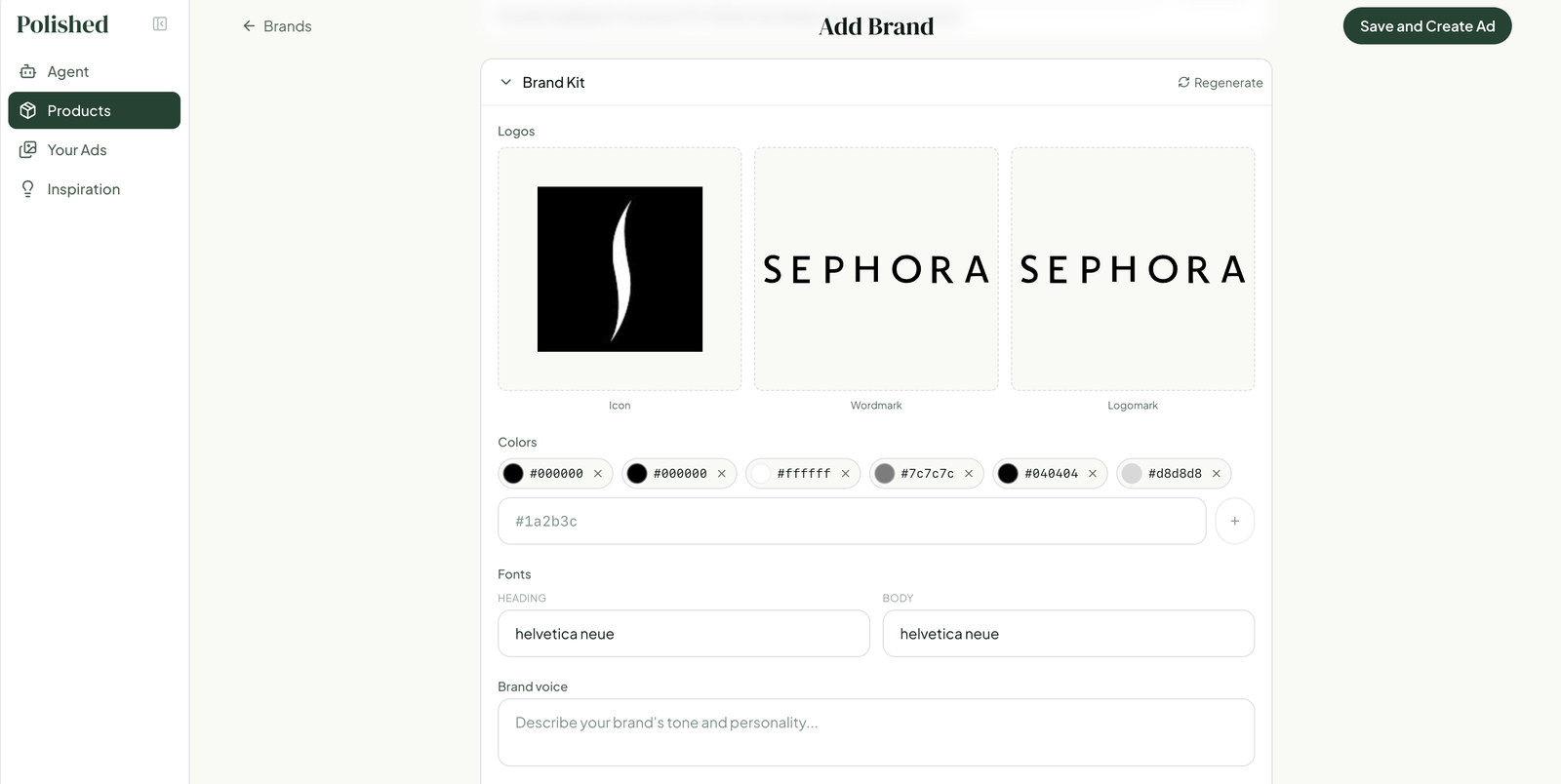
Context.dev powers Polished's Brand AI detection. When a user adds a brand, Polished can pull brand assets from the company's website and use them to build the brand profile that downstream ad generation depends on.
That includes:
- Logos and usable visual assets
- Brand colors and typography
- Company and product context
- Brand voice signals that help ads sound specific to the business
- Markdown-ready website content that can feed the product knowledge base
Instead of starting every ad from a blank prompt, Polished starts from the live brand surface the company already has.
Getting started
The integration was intentionally small. Polished did not need a long implementation cycle before seeing useful output from the API.
"Getting started was super simple. Kudos to great docs and logical API layout. Honestly was up and running with a test in under a minute and after confirming the response structure on some real input data, we had everything set up to run in 10 minutes."
That speed mattered because brand setup is a first-mile workflow in Polished. The quicker the team could trust the response shape, the quicker they could wire the data into product flows that users touch every time they create a brand or generate an ad.
Brand assets plus knowledge base context
For Polished, Context.dev is not only a logo or palette lookup. The team also uses Context.dev's data extraction capabilities to power the knowledge base behind the ad agent.
The Crawl Markdown API gives Polished a clean way to turn customer web pages into LLM-ready markdown. That markdown can carry product descriptions, positioning, use cases, proof points, and other page content into the system that plans and writes ads.
That creates a more useful brand profile:
- The brand kit supplies the visual rules.
- The extracted markdown supplies the product and messaging context.
- The ad agent combines both when generating and iterating creative.
The result is a setup flow that can move from "enter a domain" to "create on-brand ads" without asking the user to manually assemble every asset and source document first.
What Context.dev unlocked
Polished uses Context.dev to make its brand layer feel automatic. A new brand can be detected, enriched, and made useful for ad generation before the user starts giving detailed creative direction.
That improves the core product loop:
- Faster brand setup: Users can start with a website instead of uploading every asset by hand.
- More reliable brand detection: Polished gets up-to-date responses that work well on real sites.
- Better ad context: Brand assets and crawl markdown give the agent both visual and messaging inputs.
- Less internal maintenance: The Polished team does not have to own every edge case in website crawling, logo detection, color extraction, and markdown preparation.
- More specific creative: Ads can inherit the customer's actual brand voice and product context from the first generation.
Why this matters for AI ad generation
Ad generation tools are only useful when the output feels like it belongs to the company running the ad. If the system only knows a prompt, the result can look generic. If it knows the brand identity and the source material behind the business, the first version can already be much closer to a usable ad.
That is where Context.dev fits inside Polished. It gives the ad agent a dependable brand and website context layer, so Polished can focus on the creative workflow: generating, remixing, translating, reformatting, and iterating until the ad is ready to run.
For teams building AI creative products, Context.dev helps turn a domain into the context an agent needs before it acts.
P.S. If you want to go from a prompt to finished, on-brand static or video ads in minutes, check out Polished.ad. The team (YC W24) is building an AI ad agent that brainstorms angles, generates visuals, writes copy, composes layouts, and lets you refine everything in plain English.