
OpenTag is a model-agnostic AI coworker for Slack and Microsoft Teams. It works where a team already collaborates, builds an up-to-date understanding of the company, and takes on operational work instead of stopping at answers.
For co-founder and CEO Tony Kam, one of those jobs is running CRM workflows from end to end. That requires OpenTag to identify people, understand their roles and backgrounds, and give sales teams enough context to decide who to target.
What is OpenTag?
OpenTag lives inside team conversations. A user can mention it in Slack or Microsoft Teams, hand it a task, and receive the result in the same thread. Behind that interface is an AI coworker that can use connected tools, complete multi-step jobs, and maintain a self-updating knowledge base of how the company works.
The model-agnostic architecture lets OpenTag choose the right model for each job. The company context it builds stays with the team even as the underlying models change.
The use case
OpenTag's customers wanted the agent to manage more of their CRM without sending a salesperson into a separate research workflow. Finding and enriching contacts was a critical part of that job.
The agent needed to answer practical questions in the moment: Who is this person? What do they do? Which company and team are they part of? Where can the user verify the result?
OpenTag could have built and maintained its own crawling, parsing, and normalization pipeline. Instead, the team looked for an enrichment API that could give the agent structured context it could immediately use.
"We needed an enrichment API our agent could actually use, not just a data dump. Context.dev's people enrichment turned out to be really good."
From documentation to a working integration in about two minutes
Tony found Context.dev through Yahia Bakour on X. The evaluation quickly became an implementation.
"Getting started took about two minutes. We pasted their prompt into our agent and it figured out the rest. It's now a core part of how OpenTag works."
There was no long integration project. OpenTag gave its agent the Context.dev prompt, the agent worked through the setup, and the new capability was ready to use.
That fast setup matters for an agent product. The team could test Context.dev through the same autonomous workflow it was building for customers, then move directly to the real CRM use case.
Research on demand, directly in Slack
With Context.dev connected, a user can ask OpenTag about a person in Slack. The agent pulls current information from the web and returns useful context such as the person's role, background, team, and relevant LinkedIn profiles, along with sources.
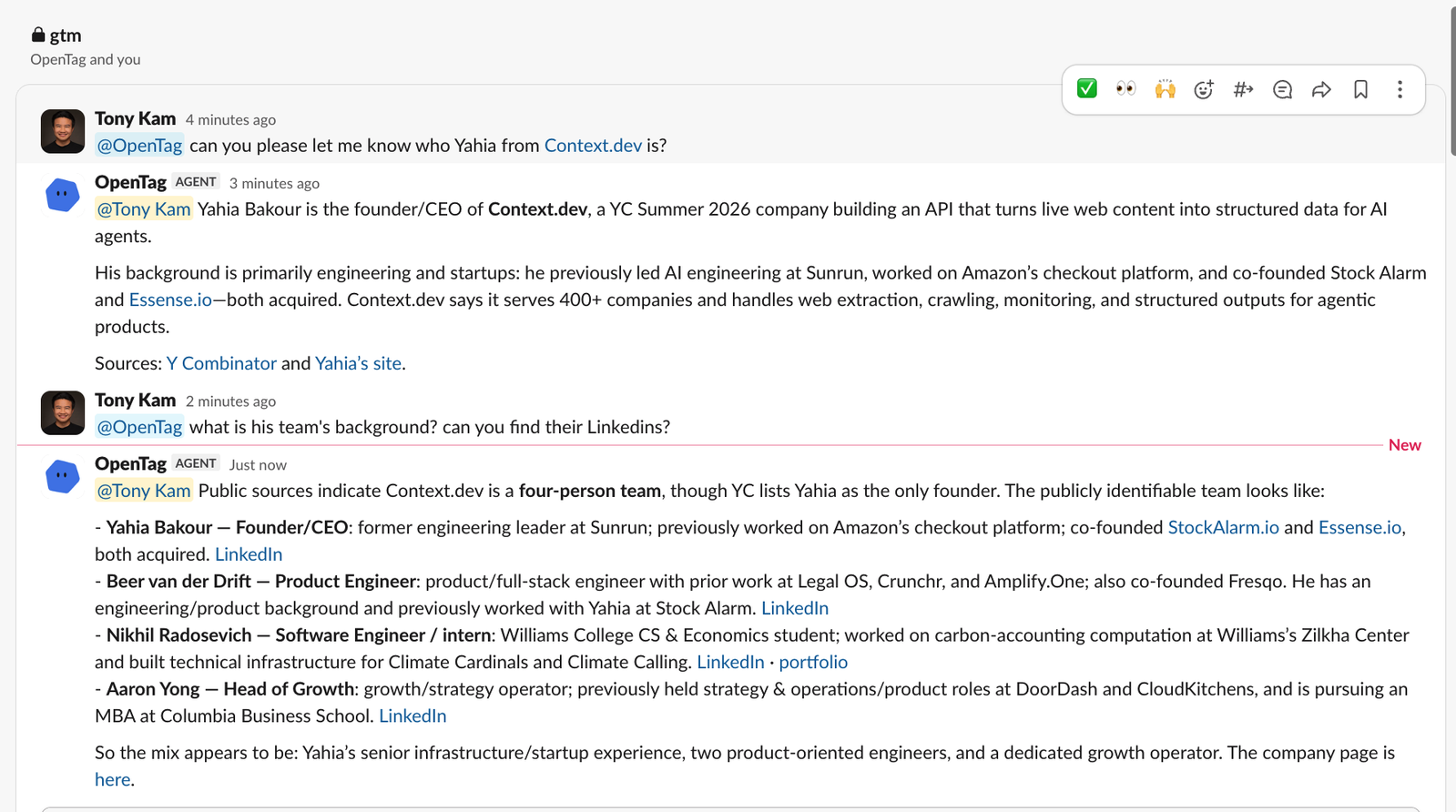
Context.dev handles the web extraction underneath that experience. It turns live pages into structured data that the agent can reason over. OpenTag decides what it needs, Context.dev fetches and structures the information, and OpenTag writes the answer back into the Slack thread where the question started.
The handoff stays invisible to the user. There is no separate research tool to open and no raw crawl output to interpret.
The outcome
People and company research is now part of OpenTag's broader CRM workflow. The agent can gather context at the moment it needs it, use that context to decide what to do next, and keep the user inside Slack throughout the process.
"We don't crawl or parse anything ourselves. The agent decides what it needs, Context.dev fetches and structures it, and OpenTag writes the answer back in Slack."
For the OpenTag team, Context.dev removed a specialized infrastructure problem while preserving the product experience they wanted: ask a coworker in a thread and get a sourced, actionable answer in return.
Key benefits
- Working in about two minutes: OpenTag's agent handled the setup from the supplied prompt.
- Structured context instead of a data dump: the enrichment output gives the agent material it can reason over and use in a larger workflow.
- Live, sourced research inside Slack: users can ask about a person or company and receive the result where the work is already happening.
- No crawling or parsing pipeline to maintain: Context.dev manages the web extraction layer for OpenTag.
- A foundation for end-to-end CRM work: person research becomes one step inside a broader task the AI coworker can complete.
A context layer for an AI coworker
OpenTag is designed to take real work off a team's plate. Context.dev gives that coworker the structured web context it needs to research people and companies without pulling OpenTag's engineers into the crawling stack.
The result is a compact integration with a large role: it helps OpenTag turn a question in Slack into live, sourced CRM context, and it took about two minutes to get working.
Building an agent that needs reliable person context? Context.dev's People Enrich API turns combined identity clues into structured person data with an identity match score.
P.S. Want an AI coworker that can research a contact and keep the work moving from the same thread? Try OpenTag.