
We recently heard from Bhanu, founder of SiteGPT, the AI chatbot platform that lets businesses spin up support chatbots trained on their own content. SiteGPT now uses Context.dev under the hood to scrape websites and turn them into the knowledge base that powers its customers' bots.
Bhanu was direct about why he made the switch:
"Firecrawl was becoming very expensive for our needs. We outgrew their highest self-serve monthly plan. Context.dev was the first alternative that came to mind. Pricing was what triggered it, and excellent, responsive support sealed the deal."
What is SiteGPT?
SiteGPT is an AI chatbot platform. It lets you create support AI chatbots based on your business content, so customers can get accurate answers in your own words instead of digging through docs or waiting on a ticket.
The product lives or dies on one thing: how well each bot understands the business behind it. A SiteGPT chatbot is only as good as the content it was trained on. If the knowledge base is thin, stale, or incomplete, the bot's answers feel generic. If it captures the whole site, every doc, integration page, and help article, the bot can actually resolve real questions.
That is why ingesting website content reliably is core infrastructure for SiteGPT, not a nice-to-have. Customers point SiteGPT at their site, and SiteGPT needs to bring in everything worth training on.
The use case
SiteGPT lets customers use their own website as the knowledge base for a bot. To make that work, SiteGPT has to crawl an entire site, recursively extract clean content from every page, and keep it fresh as the site changes.
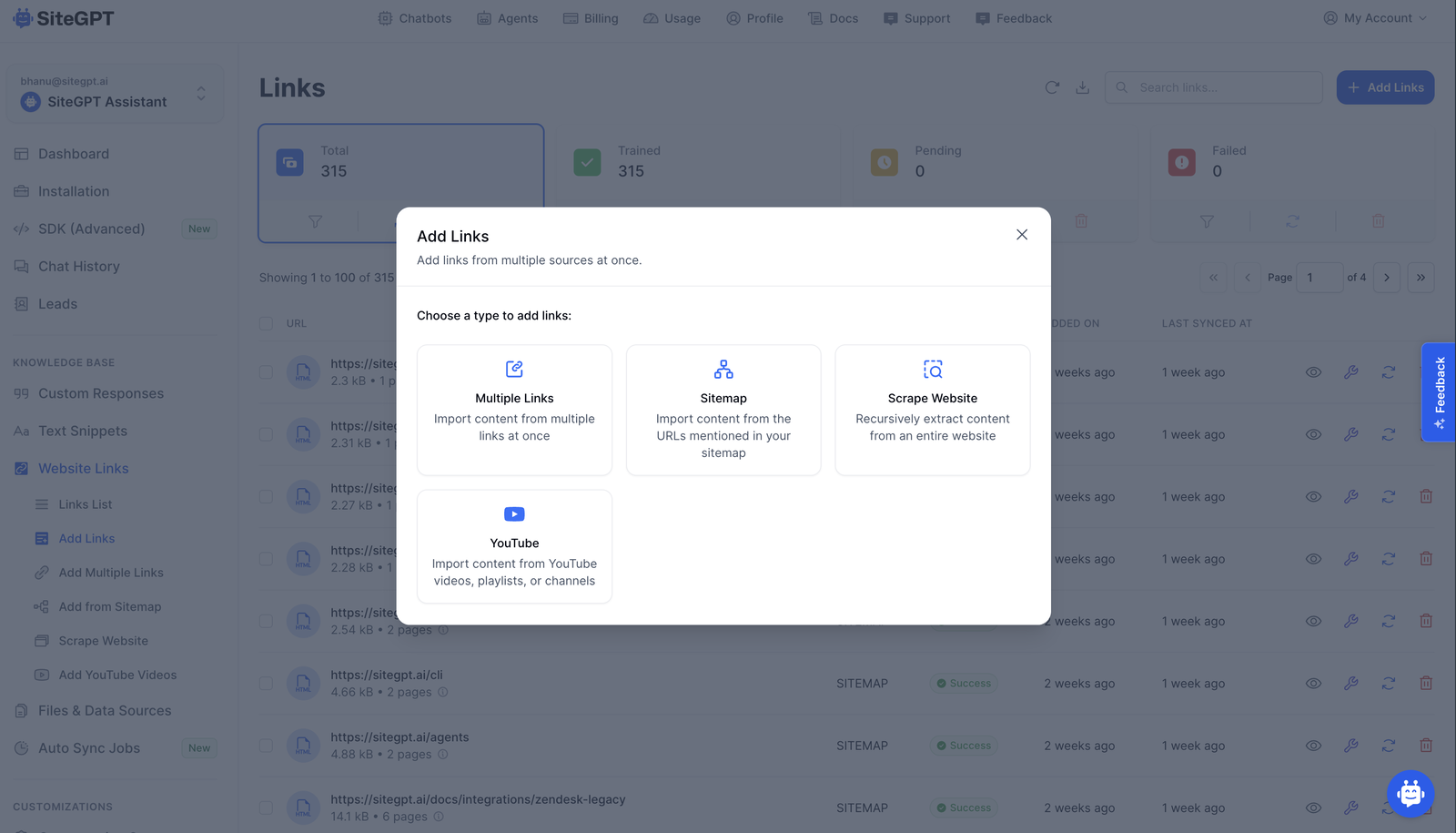
Inside SiteGPT, that shows up as the "Scrape Website" option: recursively extract content from an entire website in one step, then train the bot on the result. Behind that button, Context.dev does the heavy lifting: crawling the site, pulling readable content from each page, and handing SiteGPT structured material it can turn into a bot's knowledge base.
The requirements are exactly the kind of thing that gets expensive to own:
- Crawl entire websites, not just a single URL
- Recursively follow and extract content across many pages
- Return clean, usable content ready to train on
- Stay reliable and affordable as the number of pages scales
How Bhanu found Context.dev
Bhanu first came across Context.dev on X (Twitter), and had already been exploring it before the switch ever became urgent.
The urgency came from pricing. SiteGPT had been scraping websites with Firecrawl, but as the platform grew, the costs grew with it, to the point where SiteGPT outgrew Firecrawl's highest self-serve monthly plan. That is a good problem to have and a real one to solve. When it was time to look for an alternative, Context.dev was the first thing that came to mind.
"Context.dev was the first thing that came to mind. I was already exploring it before. Pricing was what triggered it. Excellent and responsive support is what sealed the deal in the end."
So the evaluation came down to two things: pricing that fit SiteGPT's scale, and support that made the team confident they could actually move.
Integration experience
The migration was fast, and the support was a big part of why.
When SiteGPT needed a couple of additions to the API to fit their scraping flow, the Context.dev team shipped them within a few minutes of being asked. That responsiveness removed the usual risk of a migration: waiting on a vendor to support your use case before you can move. Once everything SiteGPT needed was present in the API, the switch took less than a day.
"It's great. You helped us make additions to your API in a few minutes when we asked. It made it very easy for us to migrate over. It took us less than a day once we had everything we needed in the API."
For a team replacing a piece of core infrastructure, "less than a day" is the headline. Migrating a website-scraping pipeline could easily have become a multi-week project. Instead, it became a same-day swap.
Key benefits
Switching to Context.dev gave SiteGPT a scraping layer that fit both its scale and its budget.
The biggest unlocks for SiteGPT:
- Pricing that scales with the product: Context.dev fit SiteGPT's volume after they outgrew their previous plan, instead of penalizing growth.
- Same-day migration: With the right API support in place, the switch took less than a day.
- Responsive support: API additions shipped in minutes when SiteGPT asked, removing migration risk.
- Whole-site knowledge bases: Recursive crawling turns an entire website into training content for each bot.
- Less infrastructure to own: SiteGPT keeps its engineering focus on the chatbot product, not on maintaining a web-scraping pipeline.
The result
SiteGPT replaced a scraping pipeline that had become too expensive with one that fits its scale, and did it in under a day.
The practical outcome:
- Migrated off Firecrawl in less than a day
- Pricing that fits SiteGPT's scraping volume
- API gaps closed in minutes by Context.dev support
- Customer websites turned into chatbot knowledge bases via recursive crawling
- Engineering attention kept on the core chatbot experience
For a platform whose whole value depends on how well each bot knows the business behind it, getting reliable, affordable website content is foundational. Context.dev now sits quietly underneath that, turning customer websites into the knowledge base that makes SiteGPT's bots useful.
Want a support chatbot trained on your own content? SiteGPT lets you turn your website, docs, and help center into an AI chatbot that answers customer questions in your own words, with no manual training required. Point it at your site and let it scrape the whole thing into a knowledge base. Check it out at sitegpt.ai.
P.S. If your product needs to turn a website into clean, structured, training-ready content, at scale and without owning a crawling pipeline, Context.dev gives you the scraping layer so your team can stay focused on what your customers actually see.