
Stan is an all-in-one creator platform that lets creators sell courses, digital products, and appointments straight from their link-in-bio. Behind the product is a team that likes to ship fast growth experiments, and one of the most fun recent ones is a leaderboard.
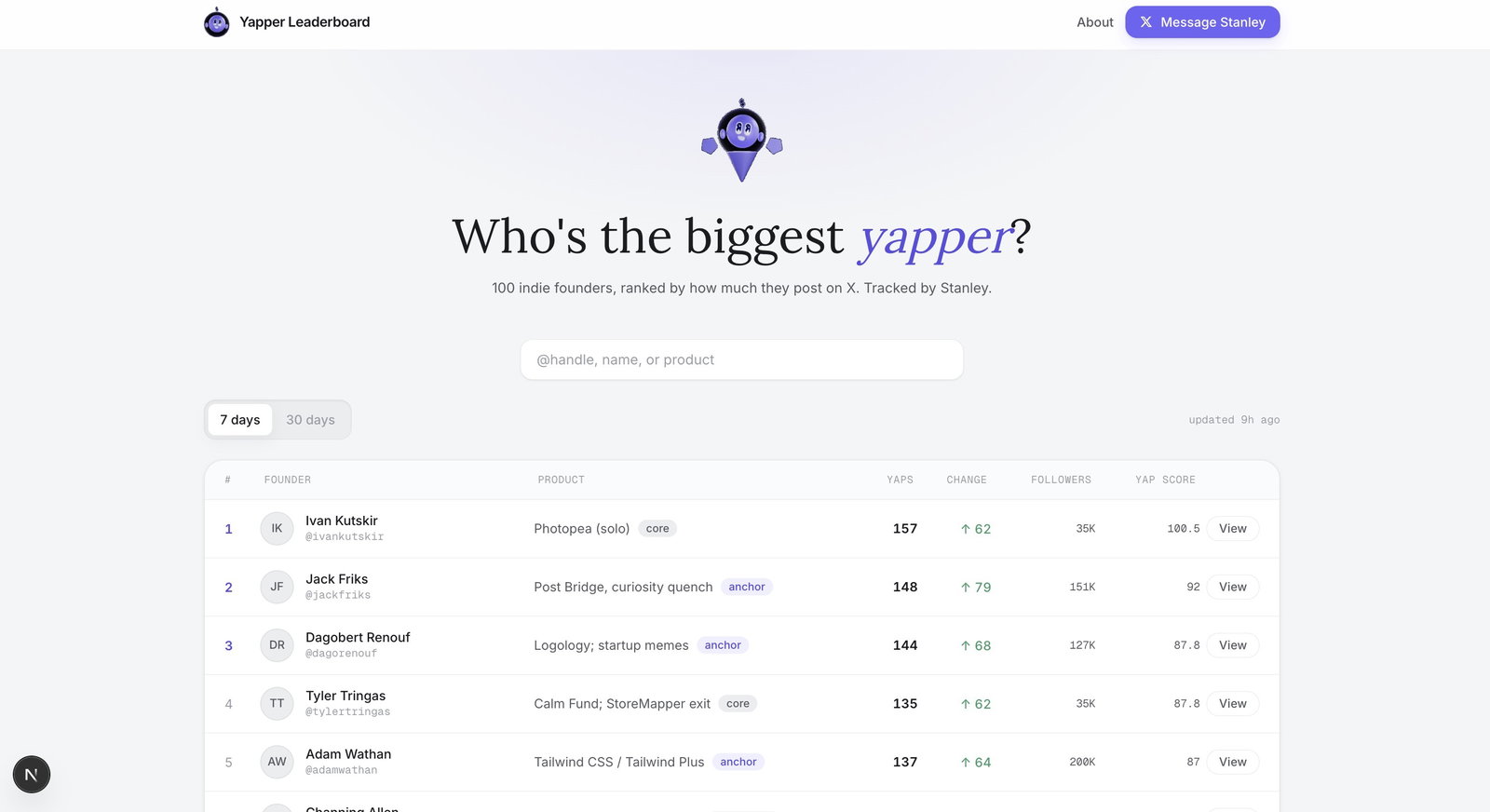
Jay Chopra runs Ops and Growth Engineering at Stan. After discovering Context.dev through a leaderboard on X, he wanted to build one of Stan's own. The result is the Yapper Leaderboard: 100 indie founders, ranked by how much they post on X, tracked by Stan's mascot Stanley.
Here's how Jay described the setup:
"Didn't take long at all, was a simple addition and it got to work."
What is Stan?
Stan is a creator commerce platform. Instead of stitching together a storefront, checkout, scheduling, and course hosting from separate apps, creators get one link-in-bio store where followers can buy in a tap. That focus on removing friction shows up in how the team builds internally too.
The Yapper Leaderboard is a good example: a small, fast project from the growth side of the company, built to see how founders would react to being ranked.
How they found Context.dev
Jay first came across Context.dev the same way a lot of people did, through a leaderboard making the rounds on X. As he put it:
"Came across Context.dev via the Twitter leaderboard. I run Ops and Growth Engineering at Stan. Chatted with Yahia and we synced really well. Wanted to make something similar ourselves, so we got the API."
That's the whole funnel: saw the experiment, liked the mechanic, talked to the founder, got an API key.
The use case
A founder leaderboard needs real context about the people on it. Every row on the Yapper Leaderboard pairs a founder's X handle with who they are and what they're building, from Photopea to Post Bridge to Tailwind CSS, alongside post counts, follower numbers, and a composite "yap score" over 7-day and 30-day windows.
Context.dev handles the web-data side of that, so the leaderboard stays a fun growth experiment instead of becoming a scraping-infrastructure project. The integration was, in Jay's words, "a simple addition and it got to work."
The outcome
"Made a leaderboard ourselves, was a fun experiment to see how others react to it!"
The experiment shipped, and reactions are the point: founders love checking where they rank, sharing it, and arguing about their yap score. For Stan's growth team, it's a repeatable pattern, and Context.dev made the data layer the easy part.
Key benefits
- Fast path from idea to shipped: the integration "didn't take long at all," so the experiment went live while the idea was still fresh.
- Web data without the infrastructure: Context.dev supplies the context behind each founder and product, no in-house scraping pipeline required.
- Built for experiments: a simple API means growth engineers can test playful ideas like a founder leaderboard without a big engineering commitment.
Want to ship your own data-powered growth experiment? Context.dev gives you scrape, crawl, brand, and extraction APIs so the data layer is the easy part.