
Adapt builds automation for insurance agencies, capturing and routing documents and notifications so agencies can run without manual data entry. Karim Yahia leads GTM Engineering there, and his work runs on web data at scale: logos across a dense map of CRM accounts, change tracking across thousands of websites, and page-level evidence for the AI agents that classify and route account signals.
Karim wanted all of that without building or maintaining scraping infrastructure. He found it in Context.dev.
"Getting started was unusually fast. I connected Context.dev to Codex through MCP, and within minutes my agent was fetching pages, discovering sitemaps, and working with structured web data, all without me having to build or maintain scraping infrastructure."
Scraping and brand data from one API
Karim found Context.dev on X while looking for a more affordable alternative to Firecrawl. The requirement was broader than scraping alone.
"I wanted reliable web scraping alongside dedicated brand endpoints for company information, logos, colors, socials, and industry data. It was exactly what I needed for Codex and our GTM workflows."
GTM work needs both halves. Scraping supplies the raw page content that signals and enrichment are built on, while brand endpoints answer the identity questions that come up constantly in a CRM: which company is this, what does it look like, and what industry is it in.
From signup to a real workflow in minutes
Adapt connected Context.dev to Codex through MCP. Within minutes, Karim's agent was fetching pages, discovering sitemaps, and working with structured web data.
"It went from signup to being genuinely useful in a real workflow almost immediately."
There was no scraping infrastructure to stand up first, and no proxy or parsing layer to maintain afterward. That mattered for a GTM engineering team whose job is shipping internal tooling, not operating crawlers.
Logos that make a 20K+ account map scannable
Adapt Map is the team's internal map of CRM accounts, more than 19,000 of them in the view below. Adapt uses Context.dev's Logo Link to add recognizable company logos to the accounts on it.
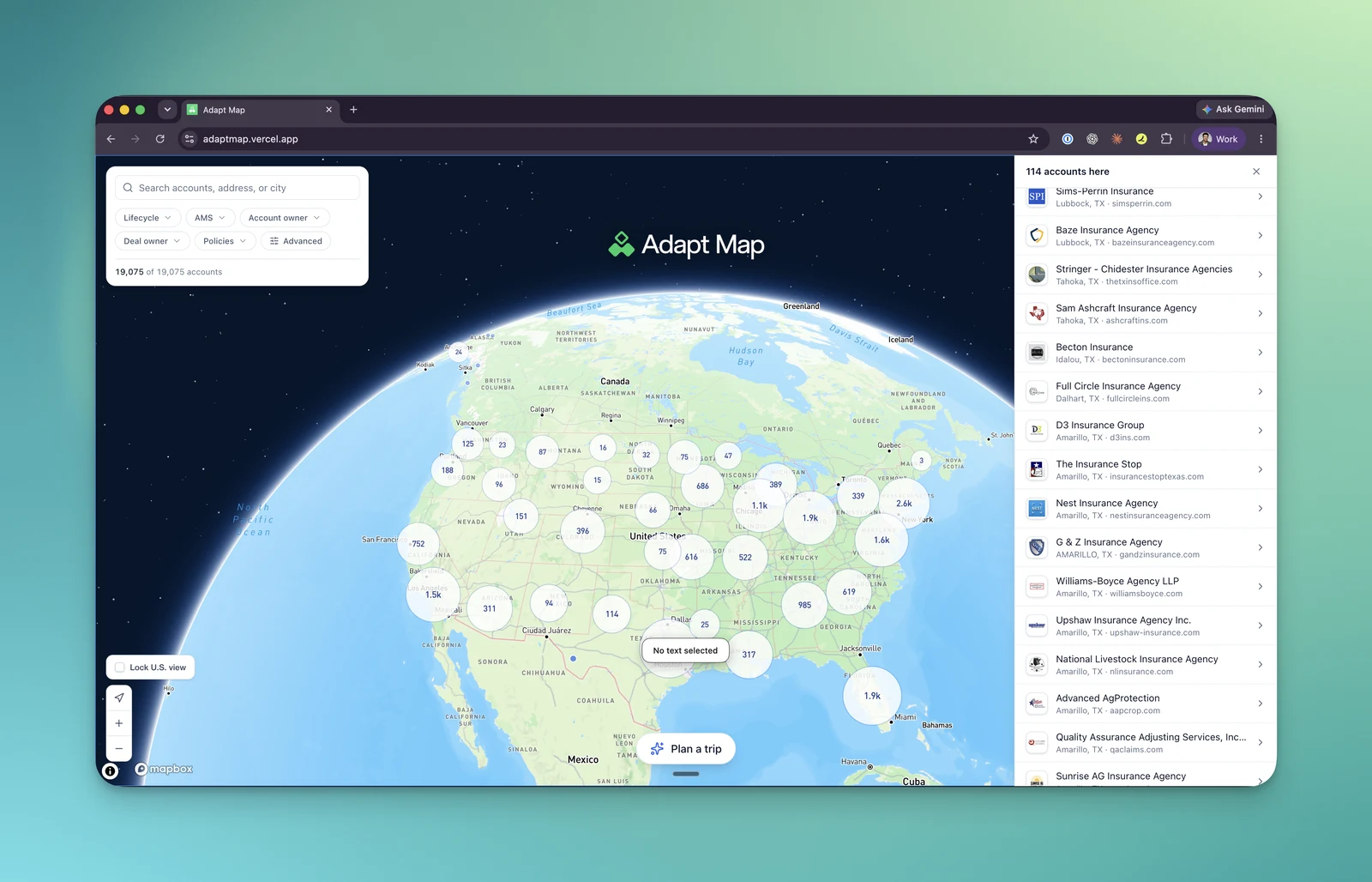
"We use Logo Link to add recognizable company logos to our internal map of 20K+ CRM accounts. It makes a dense operational tool much easier to scan, without us having to source and maintain thousands of logo assets ourselves."
At that volume, sourcing logos by hand is not a realistic option. Logo Link turns an account's domain into a logo URL, so the map stays visual without anyone maintaining an asset library.
Signals from roughly 6,000 monitored websites
Adapt runs Context.dev Monitors across roughly 6,000 account and industry websites. When a meaningful change happens, like a new office opening or a change of leadership, Adapt's system evaluates the account, determines the priority, and routes the signal to the right account executive in Slack.
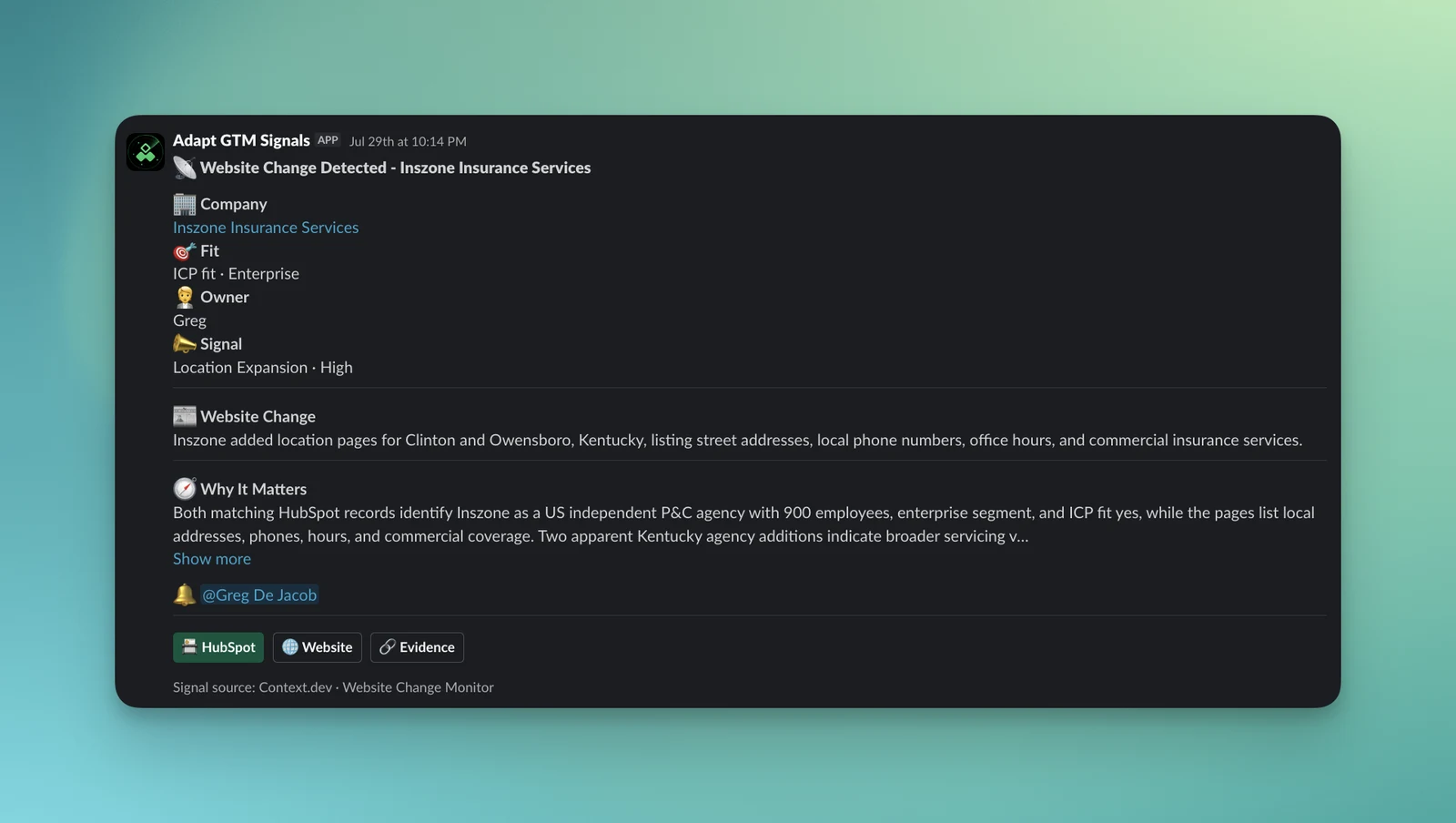
"The monitors were easy to set up, and they give the entire team a simple way to track their accounts and decide where to focus without manually checking websites."
Instead of account executives checking websites by hand, the websites now report their own changes, and the team decides where to focus based on prioritized signals.
An evidence layer for GTM agents
Context.dev is also part of the evidence layer behind Adapt's GTM agents. Before a signal is classified and sent to HubSpot or Slack, the agents use Context.dev to resolve the right company and domain, discover relevant pages, and retrieve usable website content.
"This has helped us recover opportunities that would otherwise have been misclassified or missed entirely."
Verification is the quiet win here. A signal routed to the wrong company, or one dropped because a page could not be read, is a lost opportunity that nobody notices. Grounding the agents in retrievable web evidence keeps those signals in the pipeline.
Key benefits
- Set up through MCP in minutes: connecting Context.dev to Codex made it useful in a real workflow almost immediately.
- 20K+ account logos with zero asset maintenance: Logo Link keeps Adapt Map scannable without a self-managed logo library.
- Roughly 6,000 websites monitored automatically: prioritized signals reach the right account executive in Slack instead of relying on manual checks.
- Fewer missed opportunities: verified company data and readable page content keep GTM signals from being misclassified or dropped.
The outcome
Adapt replaced the scraping infrastructure it never wanted to build with one API. Context.dev now puts logos on a map of 20K+ CRM accounts, watches roughly 6,000 websites for meaningful changes, and supplies the web evidence that keeps Adapt's GTM agents accurate, all starting from an MCP connection that was genuinely useful within minutes of signup.
Building GTM tooling that runs on web data? Context.dev turns any domain into logos, brand data, monitored changes, and structured page content your workflows can act on.
P.S. Want your insurance agency to run better on autopilot? Learn more at Adapt.