
API update
This article includes examples from before the API consolidation. Use these current endpoints for new integrations; the older examples below are retained for reference.
| Earlier API | Current API |
|---|---|
| Separate HTML, Markdown, image, byte, and screenshot APIs | Scrape Anything: POST /v1/web/scrape. Select outputs with formats. Read markdown.data, html.data, images.data, or screenshot.data. Screenshots are image data URLs. A request shares one base charge across selected formats. |
Current Scrape request:
curl --request POST 'https://api.context.dev/v1/web/scrape' \
  --header "Authorization: Bearer $CONTEXT_DEV_API_KEY" \
  --header 'Content-Type: application/json' \
  --data '{
  "url": "https://example.com",
  "formats": {
    "markdown": true,
    "html": true
  }
}'
See the current API catalog, pricing, and OpenAPI specification for current parameters, responses, and costs.
Spikonado builds tools that make robotics development faster. Its founder and CEO, Aarav Gupta, is building Sprocket, an AI engineering agent that works across hardware, dependencies, tools, and frameworks.
That breadth creates a context problem. Sprocket needs to understand the technologies in each project, but documentation changes constantly. Spikonado needed a dependable way to give the agent current information without building and maintaining its own scraping infrastructure.
Context.dev gave Sprocket that layer in about an hour.
"The API integration was pretty easy, and the API was incredibly reliable and worked well. It took about an hour to integrate it."
An engineering agent is only as current as its context
Coding agents can write plausible code from what they already know. Reliability drops when a project depends on a newer API, an unfamiliar framework, a hardware-specific constraint, or documentation that changed after the model was trained.
That was the problem Spikonado set out to solve. Sprocket needed a way to pull current documentation for the exact tools and dependencies involved in a task, then make that context available while the agent worked.
"We ended up looking for such APIs as we needed a way to give coding/engineering agents up-to-date context on the tools/dependencies/frameworks they were using."
From a hackathon mention to a production integration
Aarav had come across Context.dev before, but it was a hackathon sponsorship that prompted a closer look. Once he explored the product, the web scraping APIs matched what Sprocket needed.
Spikonado is not using Context.dev's Brand API in Sprocket. It uses the Markdown API to turn documentation pages into clean content the agent can use.
The first implementation was deliberately simple: give Sprocket a Markdown scraping tool and let it fetch the documentation relevant to its work.
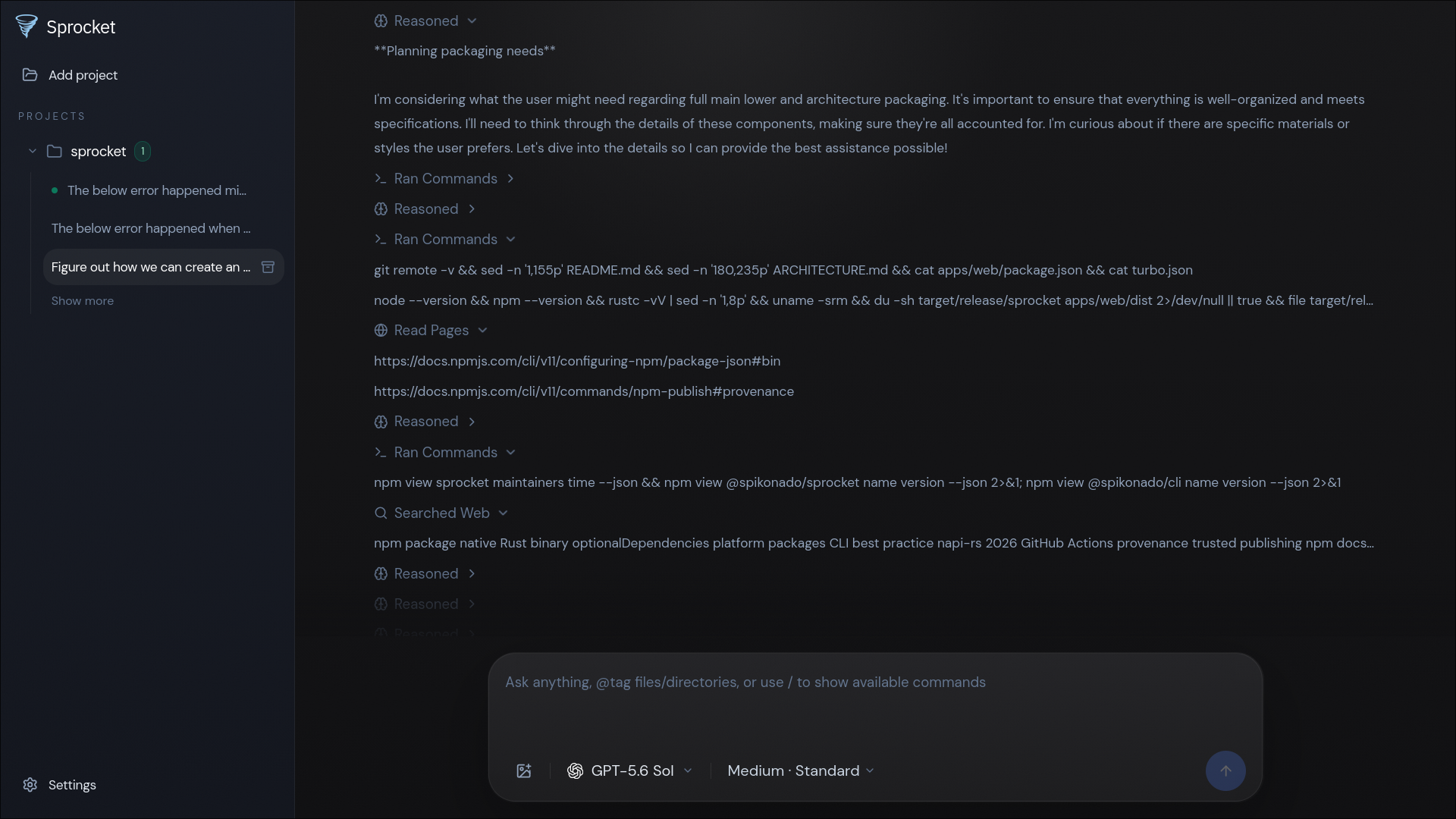
Integrated in about an hour
Aarav planned to use Context.dev through its Convex component. During implementation, the agent wired the API directly instead. The result still worked, and the full integration took about an hour.
Testing surfaced one narrow edge case: a small number of URLs, including some GitHub blog pages, did not satisfy the types defined by the Convex component. Aarav described those failures as incredibly rare and not a blocker.
What stood out more was how little operational work the integration required.
"The API was incredibly reliable and worked well."
Current documentation, more reliable results
With Markdown scraping available as a tool, Sprocket can pull current context on the hardware, tools, frameworks, and dependencies it is using instead of relying only on what the underlying model already knows.
"This has allowed us to equip the agent with up-to-date context on the hardware, tools, frameworks, etc. it's using, and thus make it massively more reliable."
The improvement does not come from changing the agent itself. It comes from giving the agent a reliable path to the source material it needs at the moment it needs it.
What Spikonado plans to build next
At the time of the interview, the first version fetched Markdown on demand. Spikonado's next planned step was to cache Context.dev responses for 12 hours, refresh them when they expired, and expose the documents through a virtual filesystem.
That would let Sprocket browse documentation with the same shell commands it already uses for code and project files. The agent could search, open, and move through documentation without introducing a separate interaction model.
Key benefits
- About one hour to integrate: Spikonado added Markdown scraping to Sprocket in a single session.
- Current context for every task: the agent can retrieve documentation for the hardware, tools, dependencies, and frameworks it is actively using.
- More reliable engineering output: Aarav says access to up-to-date context made Sprocket massively more reliable.
- A simple path to deeper agent workflows: cached documents and a virtual filesystem can make documentation available through the agent's existing shell tools.
The outcome
Spikonado did not need to build a documentation ingestion stack before improving Sprocket. In about an hour, Aarav gave the agent a reliable way to fetch current technical context and saw a meaningful improvement in how dependably it handled engineering work.
Building an agent that needs to understand fast-moving tools and frameworks? Context.dev turns any documentation page into clean Markdown your agent can use at runtime. Start with the Markdown API.
P.S. Building robots or robotics applications? Learn more about Spikonado and Sprocket.