



Agently builds a company brain for startup teams. Connect your stack, and it builds a persistent model of your company that agents can work from. The next task starts with what the company already knows.
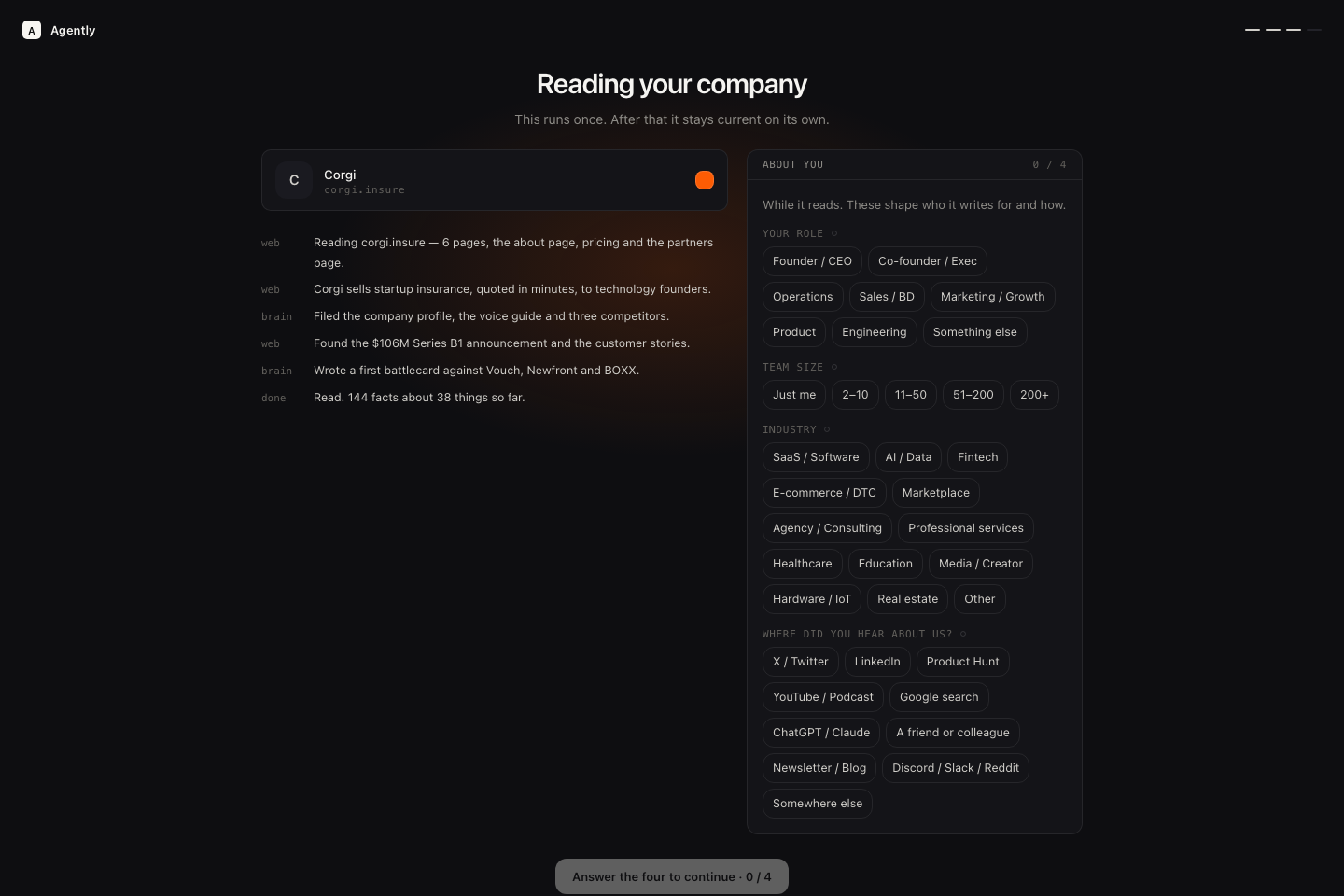
For founder Omar Ghandour, that experience starts before a user has finished signing up. They enter a website, and Agently begins learning the company in front of them. Context.dev powers three parts of that workflow: the brand card, the first website crawl, and the research agents do next.
The first minute has to do real work
Agently needs to make the workspace feel like the user's company immediately, then start filling its brain with useful information.
"That first minute needs the logo, the colours and the site name before the user gets bored, and it needs the whole site crawled right after."
Omar already had Firecrawl in production. It handled crawling, but his setup meant starting a job, polling for results, and designing around a four-minute ceiling. It also left the brand lookup unsolved.
A branded workspace in about 300 milliseconds
Context.dev's brand lookup gives Agently the logo, company name, and palette from the domain. Omar reports a response time of about 300 milliseconds, fast enough for the signup card to resolve while the user is still looking at it.
The workspace then takes on those colors and that logo. A new user can recognize their company without finding an image to upload or copying hex codes into a settings form.
One call to read the company
Once the brand card is in place, Agently runs a shallow crawl of the company's website during onboarding. Context.dev returns the crawled pages together as clean, JavaScript-rendered Markdown in one synchronous call, with a time budget set by Agently.
Those pages become the first facts in the brain. Agently uses them to seed a company profile, a voice guide, and a competitor list, giving its agents something concrete to work from immediately.
Five snippets instead of thousands of tokens
The third use came from looking at research costs. Agently's agents had been using the model's built-in web search, which brought 10,000 to 25,000 tokens of page text into every call.
When Omar measured one onboarding research mission, that search tool accounted for 42% of the spend. It was a large part of the bill for a step that often only needed a few relevant results.
Agently switched its agents to Context.dev's search. Now they receive five snippets in roughly 385 tokens for one credit, and fetch the full page only when a mission needs a quote.
Omar's assessment:
"Same answers, a fraction of the cost."
In production that afternoon
The migration fit into a single afternoon. Omar installed the SDK, replaced the scraper service behind Agently's brain, and removed the polling code that the old crawl flow needed.
"I installed the SDK, swapped the scraper service behind our Brain, and deleted the polling code the same day."
There was one practical adjustment. In Omar's setup, the SDK's default request timeout was 60 seconds, shorter than his 80-second crawl budget. He raised the client timeout above that budget so the request could finish.
The outcome
Context.dev now supports three features inside Agently, from the first moment of signup through ongoing agent research:
- Branding in about 300 milliseconds: the domain becomes a recognizable company card, and the workspace adopts its logo and colors.
- Company context from one crawl: website content seeds the brain's first profile, voice guide, and competitor list.
- Leaner research calls: five search snippets arrive in roughly 385 tokens, with full pages fetched when the mission needs them.
- An afternoon to production: the scraper swap shipped the same day, and the polling code came out.
For Agently, a website is enough to start making the product useful. The workspace looks familiar, the brain has its first facts, and the agents can keep researching without bringing thousands of tokens into every search call.
Building onboarding that starts with a website? Explore Context.dev's brand data and web tools for AI agents.
P.S. Want agents that remember how your company works? Meet Agently.