For Sherwood Callaway, founder of Sazabi, onboarding a new customer starts with understanding what they run. Sazabi automatically discovers each customer's tech stack so it can recommend how to instrument their system. That discovery used to rely only on the customer's codebase.
Context.dev added the website. Sazabi now scans each customer's site to find client-side technologies that a codebase scan does not see, and the team went from signing up to live in production in a matter of minutes.
What is Sazabi?
Sazabi is an AI-native observability platform. Sherwood describes it this way:
"I'm Sherwood, founder of Sazabi. We're building an AI-native observability platform for fast-moving engineering teams (like Datadog but rebuilt from the ground up in 2026)."
Instead of dashboards, teams ask Sazabi questions about their systems in conversation, and Sazabi identifies root causes and works with coding agents to fix them. That works best when Sazabi is connected to the rest of a team's stack. Users can connect 53 products, spanning hosting platforms, analytics, monitoring, support widgets, authentication, and payments.
Live in production in minutes
Sherwood found Context.dev through the YC community, where Sazabi is part of the P26 batch. Getting started took almost no time:
"Context was extremely easy to get started with. We went from signing up to live in production in a matter of minutes."
Adding the website to tech-stack discovery
Sazabi's codebase analysis still runs on its own, on the repositories customers connect. Context.dev gives it a second source of evidence:
"When customers onboard to Sazabi, we automatically discover their tech stack so we can make recommendations on how to instrument. In the past, we only scanned their codebase. But with Context, we can also scan their website to discover client side technologies - and also build a better baseline understanding of what the company's product does."
Website discovery runs as a deterministic pipeline:
- Determine the company's website from a member's work-email domain.
- When that domain is not useful, fall back to Context.dev's brand lookup.
- Retrieve the rendered homepage HTML with Context.dev.
- Combine the rendered HTML with Sazabi's own direct HTTP fetch, which captures response headers.
- Run deterministic fingerprints over the combined evidence to identify hosting platforms, analytics, monitoring, support widgets, authentication, payments, and browser-visible backends.
Sazabi currently recognizes 26 website signals that map to those 53 connectable products. No step in the pipeline relies on an agent, and Context.dev fit into it cleanly:
"The API is straightforward enough to integrate into a deterministic, non-agent workflow."
The same email-first approach powers a separate workflow that finds logos for the organizations on Sazabi's platform:
"Email-based brand lookup has been materially more reliable than matching by organization name."
Rendered HTML reveals what the raw page hides
Many of the tools Sazabi looks for load on the client. Analytics snippets, support widgets, and other third-party scripts often appear only after JavaScript runs, so they are missing from both the codebase scan and a plain HTTP request. Context.dev returns the page as a browser sees it:
"Rendered HTML is genuinely useful. It exposes client-side analytics, support widgets, and other scripts that frequently do not appear in the original HTML."
Every recommendation backed by evidence
Each detection traces back to something concrete on the page:
"Context.dev lets us keep the detection process evidence-grounded. We only recommend something when we can point to a script, asset host, or response header."
Sazabi compared this against its previous approach, which generated website recommendations with an agent. In an initial evaluation across ten organizations, the difference was clear:
"In an initial ten-organization evaluation, every Context.dev-assisted detection was grounded in actual page evidence. Our previous agent-generated website recommendations were typically 2–5× larger because they included guesses derived from search results."
Fewer, verifiable recommendations mean customers see suggestions for tools they actually run, instead of a longer list padded with guesses.
A fuller picture of system architecture
Everything Sazabi discovers feeds its picture of a customer's system. The Components page below lists the services and infrastructure that make up a system, each with a description of what it does and seven days of operational status.
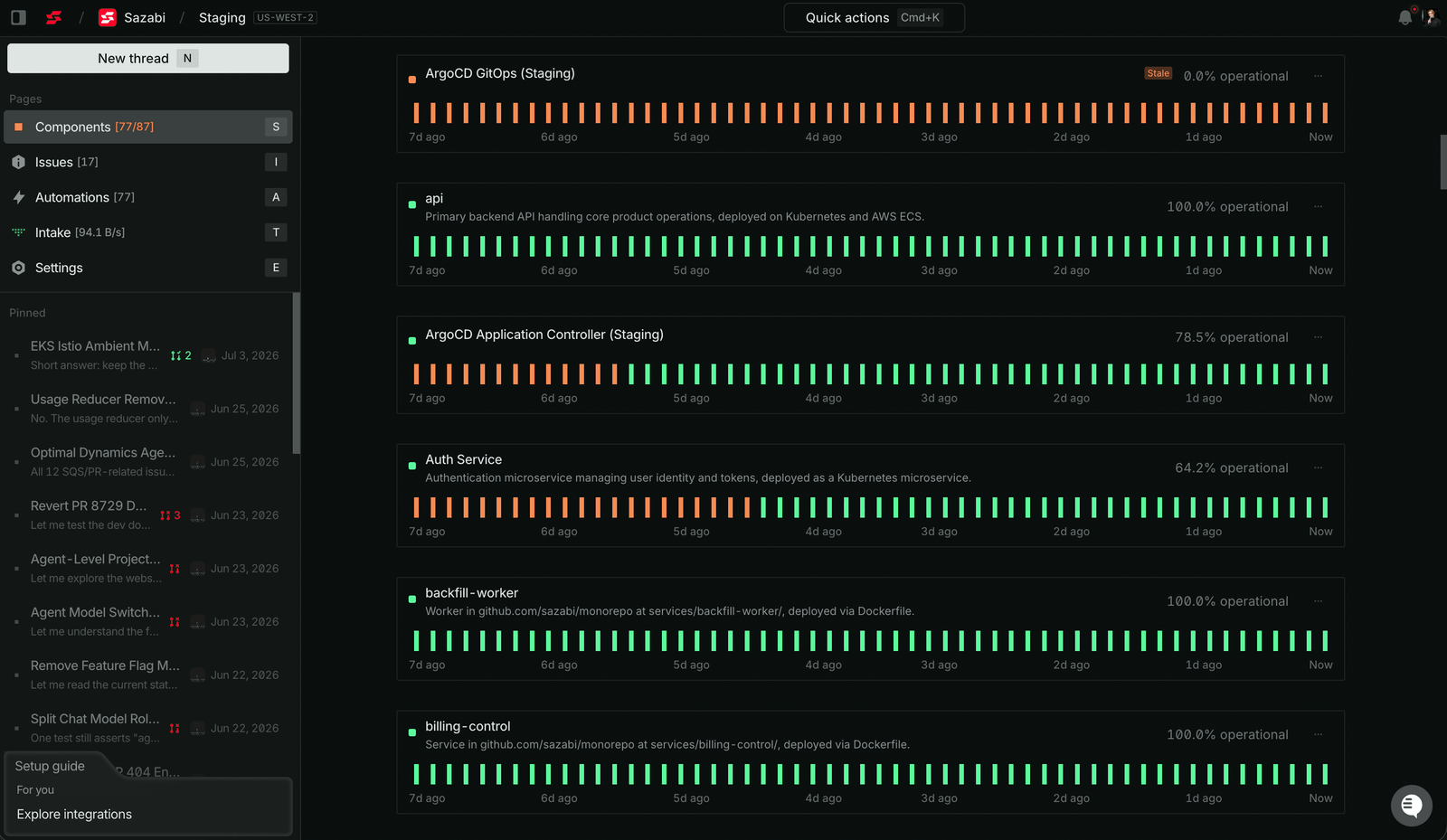
Context.dev widened what that picture can include. Sherwood describes the result:
"Since adding Context to Sazabi, we've improved our ability to discover the components that make up a customer's system architecture - especially when it comes to discovering components and technologies that exist on the client side."
The outcome
Context.dev now supplies the rendered pages behind Sazabi's website discovery, and every detection Sazabi extracts from them is tied to evidence on the page. Sherwood sums up where it adds the most:
"Context.dev has been a useful precision-oriented supplement to our tech-stack discovery. The strongest value for us is rendered, evidence-grounded website inspection."
For Sazabi, that adds up to several practical benefits:
- Pages as a browser sees them: rendered HTML exposes client-side analytics, support widgets, and scripts that often do not appear in the original HTML.
- Client-side coverage: website scanning finds the technologies a codebase scan misses, along with a better baseline understanding of what each company's product does.
- Evidence for every detection: each recommendation points to a script, asset host, or response header.
- Tighter recommendation lists: in a ten-organization evaluation, every Context.dev-assisted detection was grounded in page evidence, while the previous agent-generated lists were typically 2–5× larger.
- Built for deterministic pipelines: the API was straightforward to integrate into a non-agent workflow, and the team was live in production in a matter of minutes.
Extracting signals from live websites? Explore the Context.dev Web Scraping API for rendered HTML and Markdown from any URL, and the Data Extraction API for structured fields.