
Tsenta is building an agentic career OS that helps people land jobs. For its networking feature, Tsenta wanted each company page to feel complete without asking the team to manually collect logos, descriptions, colors, social links, and industry context.
Agnay, Tsenta's founder and a YC S26 founder, met Yahia in April 2026 and started testing Context.dev with free credits. The API quickly became the brand-data layer behind Tsenta's new company pages.
Here's how Agnay put the integration:
"API integration barely took 5 minutes with Claude Code. Super simple to use and setup."
What is Tsenta?
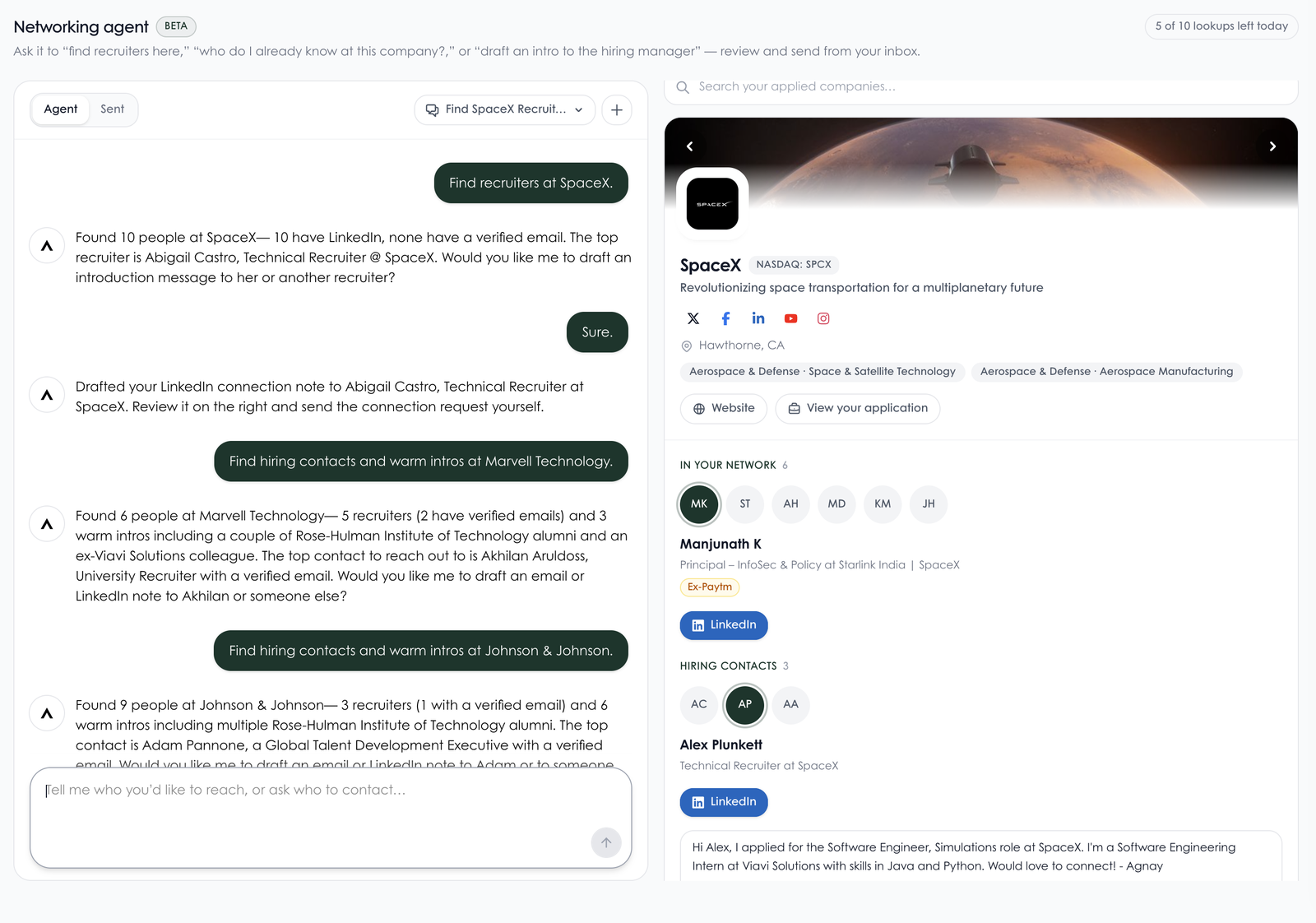
Tsenta is a career operating system for job seekers. Its networking agent helps users ask practical questions like who they already know at a company, which recruiters to contact, and how to draft a warm intro or connection note.
That workflow needs company context close at hand. When a user asks the agent to find recruiters or warm intros, the surrounding company page should show the company identity, not a blank profile or a manually assembled card.
The use case
Tsenta uses Context.dev to fill the brand side of its company pages. In the screenshot above, the right-hand panel shows the company logo, backdrop, description, social links, location, industry tags, and website entry points while the networking agent works through contacts on the left.
That extra context gives the product what Agnay called "the minimal pop" Tsenta wanted: enough brand detail to make every company feel recognizable, without turning the interface into a heavy research dossier.
How they found Context.dev
Agnay first heard about Context.dev from Yahia in April 2026. At the time, Tsenta was building its networking feature and needed a clean way to create polished company pages from a domain.
The confidence in the product was enough for Agnay to skip a long vendor search. As he put it:
"He was so confident in his product, I didn't bother looking further, and I can see why now."
Integration experience
Tsenta wired Context.dev into the product with Claude Code in roughly five minutes. The integration was small because the API returns the brand information Tsenta needed in one place instead of forcing the team to scrape, normalize, and stitch data together themselves.
For an agentic product, that matters. The team can spend time improving the job-search workflow instead of maintaining a fragile company-profile pipeline.
Key benefits
- Company pages in minutes: Tsenta could create beautiful company pages for its networking feature without building brand extraction in-house.
- Richer networking context: Users see recognizable company identity next to recruiter and warm-intro workflows.
- Agent-friendly integration: Claude Code wired the API in quickly, keeping the implementation small.
- Polished product feel: Logos, backdrops, descriptions, and metadata give each company page the visual clarity Tsenta wanted.
By using Context.dev, Tsenta turned company-page enrichment into a straightforward API call and kept the team focused on the career workflows that matter to job seekers.
Want to make every company page in your product feel complete from a single domain? Context.dev gives you the brand data layer so your agents and product surfaces can ship with real company context.