
We recently heard from Khaled Azar, founder of Kyndir, the agent-first operating system for SMB brokerage firms. Kyndir gives brokers one source of truth across contacts, nurturing, BOVs, deal pipelines, engagement, onboarding, listings, CIMs, buyer flow, and closing. Khaled came to Context.dev while looking for a way to scale design.md-style brand files inside Kyndir's brokerage workflows.
The short version: Context.dev was a better fit than expected.
"Super easy, platform is clear, and they easily pass the buy vs build test. Amazing job. Integration took less than 5 minutes."
What is Kyndir?
Kyndir is the agent-first operating system for SMB brokerage firms: eight modules, one source of truth, and one agent surface from the first Fathom call to the closing wire. It is not a CRM or generic AI, but a brokerage-shaped workspace where brokers can chat with agents that propose actions across the deal lifecycle.
Those workflows create a lot of client-facing material: brand guides, proposals, listing copy, marketing assets, CIMs, teasers, and buyer-facing deal content. For Khaled, brand context is not a decorative add-on. It is one of the inputs that helps those outputs feel specific to the company, seller, buyer, or brokerage firm they are for.
That kind of product depends on a clean context layer. If Kyndir knows a company's visual identity and public context, it can generate work that feels intentional. If it only has a name and a placeholder logo, the output feels generic.
Khaled wanted Kyndir to scale that brand-context layer without turning his own roadmap into a web-scraping and asset-normalization project.
The use case
Kyndir needed a way to pull detailed brand information into its own product flow. The goal was not just to grab a logo. Khaled needed brand context rich enough to support broker workflows and client-facing deliverables.
That means the kind of information a brand guide and proposal workflow cares about:
- Logos and visual assets
- Colors and identity signals
- Company context
- Enough structured detail to generate repeatable brokerage outputs
The feature would sit throughout Kyndir's software, not off to the side. Once brand context is available, it can power the first version of a brand guide, shape proposals, and eventually help brokerage teams create assets that reflect both their own firm and the companies they work with.
How Khaled found Context.dev
Khaled found Context.dev while trying to give his software a way to scale design files for its users.
"I found context.dev trying to get my software a way to scale design.md files for its users. This was the perfect fit and frankly better than I expected."
That framing matters. This was not a search for a nice-to-have enrichment widget. It was a build-or-buy decision around a feature that would be used across the product.
Kyndir could have built the brand layer internally. But that would have meant owning the messy parts: crawling sites, handling weird markup, finding the right assets, normalizing visual data, keeping results fast, and maintaining all of it as websites change.
Context.dev let Khaled skip that entire maintenance surface.
Integration experience
The integration did not become a project.
Khaled described getting started as simple: the platform was clear, the API fit the job, and the integration took less than five minutes. That speed is important because it changes the evaluation from "should we dedicate engineering time to this?" to "can this be working before the next feature planning conversation?"
In Kyndir's case, the answer was yes.
Why buy beat build
The strongest signal in Khaled's feedback was the buy-vs-build test.
"Using Context.dev, we skipped having to write code and maintain a feature that we use throughout our software."
That is the whole tradeoff. Kyndir still gets the product capability: brand context inside its own workflows. But the team does not have to own the infrastructure underneath it.
The avoided work is not just the first implementation. It is the long tail:
- Keeping brand extraction reliable across different websites
- Handling incomplete or inconsistent company pages
- Updating logic when sites redesign
- Normalizing data into something a product can trust
- Supporting the feature once customers depend on it
For a product like Kyndir, that is a distraction. The core value is in the brokerage workflows, agent proposals, approval queues, auditability, and client-facing outputs around a deal. Context.dev turns brand data into an API call, so Kyndir can spend its product energy on the layer customers actually see.
What Context.dev unlocked
Once Context.dev was in place, Kyndir could use brand data throughout the product instead of treating it as a one-off import step.
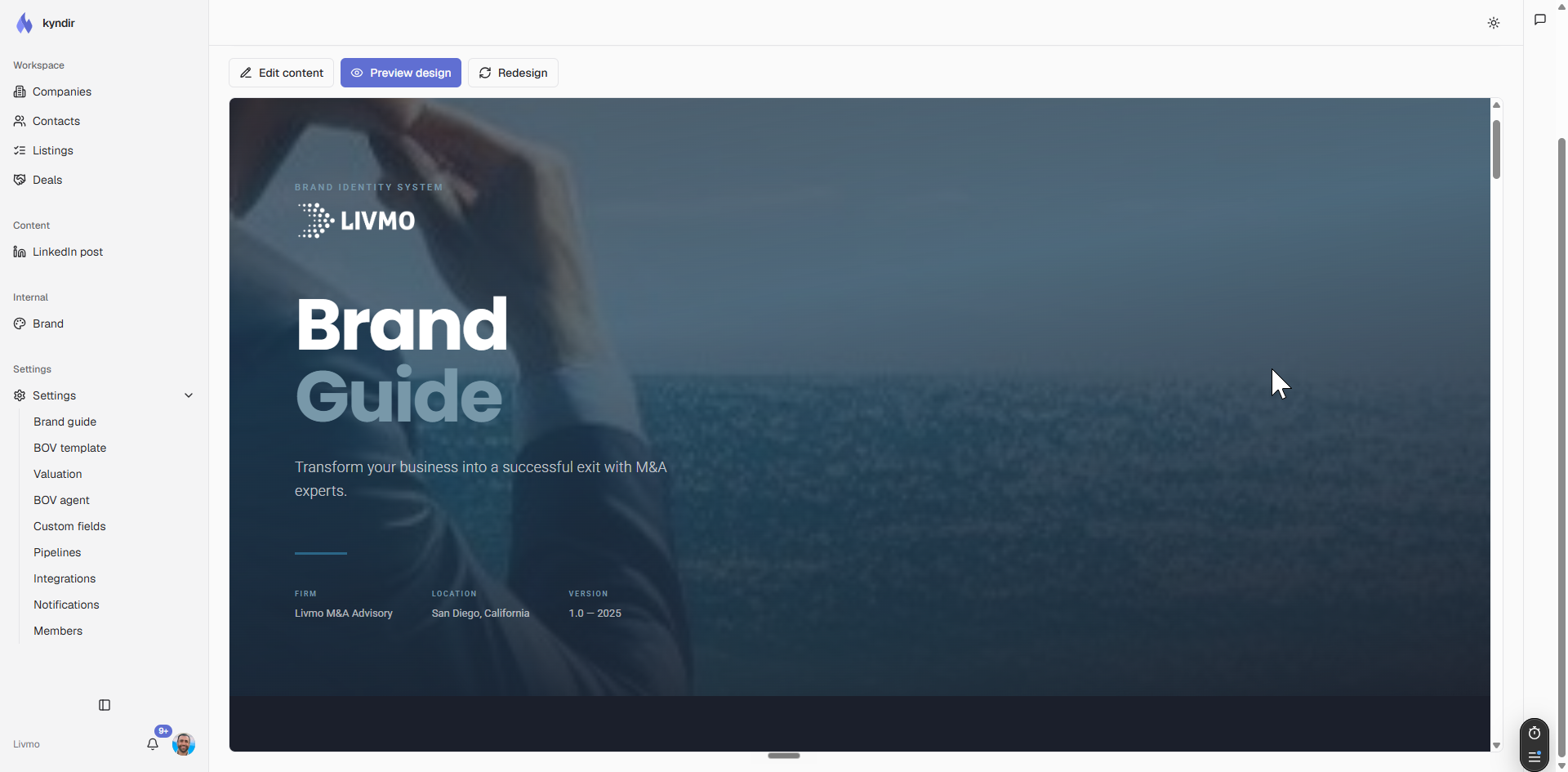
The immediate result was better brand guides. Because Context.dev pulls in detailed brand context quickly, Kyndir can create guides that start with real visual and company signals instead of asking users to fill everything in by hand.
That same context can flow into proposals, listing assets, CIM support, marketing content, and other generated brokerage materials. The more Kyndir understands about the company behind a deliverable, the more specific the output can be.
"The brand guide is a key aspect of Kyndir, that allows its users to create custom deliverables for their clients. Because it pulls in everything in detail and quickly, we can now create amazing brand guide, proposals, and other assets."
The win is not only speed. It is leverage. One reliable brand lookup can support many downstream outputs.
What comes next
Khaled is already thinking past the first use case.
Today, Context.dev helps Kyndir create better brand guides, proposals, listing-adjacent assets, and other client-facing brokerage materials. Next, Khaled wants users to customize deliverables not only with their own brokerage brand, but also with their clients' brands on the assets.
That is where a brand API becomes especially useful. The workflow can shift from "upload your assets" to "tell us the company and we'll bring the context in." For users creating client work, that removes friction at exactly the moment where speed and polish both matter.
The result
Kyndir got the brand-context layer it needed without building and maintaining it internally.
The practical outcome:
- Less than five minutes to integrate
- No custom brand-scraping feature to maintain
- Brand guides powered by richer company context
- Broker proposals and assets that can inherit real brand signals
- A path toward client-brand customization across deliverables
Khaled summed it up simply:
"Great build!!"
For a founder building software that helps SMB brokerage firms run deals end-to-end, that is the kind of infrastructure decision that matters. The feature exists. The maintenance burden does not. And Kyndir can keep moving toward the part of the product its users actually care about: better brokerage workflows, faster.
P.S. If your product needs to turn a company domain into usable brand context for guides, proposals, onboarding, or generated assets, Context.dev gives you the brand layer without asking your team to become web-scraping infrastructure engineers.