
We spoke with Michael Levin, cofounder of Drip (YC P26), about how the team uses Context.dev to give their AI drafting agents reliable context from across the web.
Drip helps sales teams reply to messages, follow up, and book meetings across LinkedIn, iMessage, Gmail, and Google Calendar. To draft replies that sound like the user, and to land on real prospects with the right offer, Drip's agents need fresh, structured context about the user's own brand and the leads they're working.
That is where Context.dev plugs in.
What Drip needed
Drip's drafting agent is only as good as the context behind it. A reply, a follow-up, or a booked meeting depends on the agent knowing:
- What the user actually sells
- Who their ICP is and which channels they reach them on
- The tone, voice, and positioning the user already uses
- Who the competitors are and what makes the user different
- Which keywords and topics belong in outbound
For Michael, getting that context cleanly from any website turned out to be the bottleneck. As he put it:
"We were looking for a clean way to give our AI agents specific context from a variety of websites. Other APIs were clunky to integrate and returned stale context or returned a hard-to-ingest format."
The team needed a single source they could point an agent at and get back something the LLM could actually use.
Where Context.dev plugs in
Drip uses Context.dev in two places that compound each other.
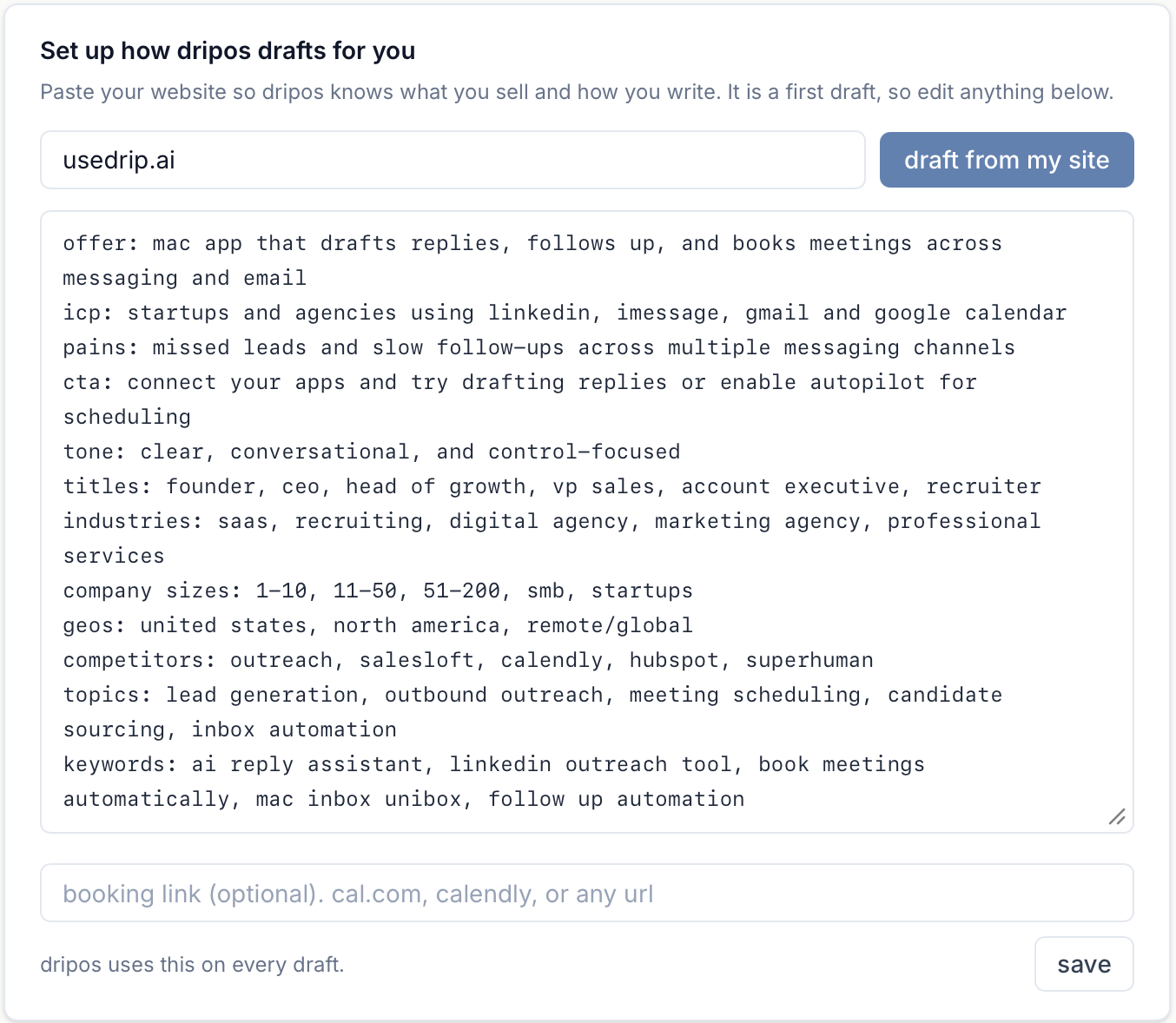
Fine-tuning Drip to each customer. When a user signs up, Drip pulls their website through Context.dev to populate the drafting profile (offer, ICP, tone, competitors, and keywords) instead of forcing the user to type it all in. The first draft the agent produces is already shaped around the user's real positioning, not a generic template.
Enriching specific leads. When the drafting agent needs to know more about a prospect or their company, it reaches for Context.dev's brand API and web search to pull live, structured context from the lead's site. That context becomes the input for the reply, the follow-up, or the booking message.
Both flows share the same primitive: turn a domain into context the agent can actually ingest.
Why Context.dev worked
For Drip, the value came down to a few things:
- Fresh, not stale. Context.dev pulls live data instead of relying on a cached crawl that no longer reflects what the site says today.
- Ingestible format. The response slots straight into agent prompts, with no custom parsing or glue code to strip noise out of raw HTML.
- One API for two jobs. The same surface powers onboarding enrichment and per-lead research, so Drip didn't need to stitch together multiple providers.
- Fast integration with hands-on help. Michael called out the rollout directly:
"API integration was smooth and the Founder was incredibly helpful and adaptive to our needs. The process took around 30 minutes once we had everything sorted out. Customer service was incredible. Ran into some small hiccups and Yahia offered to sit down and chat with an engineer to flatten out all our issues in a short call."
The result
With Context.dev underneath, Drip's agents start every draft with real context (about the user and about the lead) rather than generic guesses. Onboarding shapes the agent to each customer's voice. Lead enrichment shapes each individual message to the prospect it's going to.
If you're building AI agents that need to understand the user, their customers, or any website in between, Context.dev gives you the brand and web context layer, so your team can focus on the product, not the scraping stack.