
Construct gives people an autonomous AI agent with its own cloud workstation. The agent can use a browser, run code, and carry out multi-step work, which makes dependable access to the live web part of the product's core infrastructure.
For co-founder and CEO Nischal Naik, that meant finding a search and crawling layer that worked reliably without turning into another system for his team to maintain.
One connector instead of a homegrown pipeline
Construct found Context.dev through its Product Hunt launch. By then, the team had already tried several providers and explored building its own crawling and scraping pipeline.
"Our product uses web search, and we tried several existing tools on the market and even experimented with building our own crawling and scraping pipeline. We were impressed by how easy Context was to integrate and how reliably it handles the workload for us."
The decision came down to two practical requirements: the connector had to be straightforward to implement, and it had to keep working once an agent began handling search tasks on its own.
From the docs to a working service in minutes
The Context.dev integration stayed focused on the job Construct needed it to do. Nischal did not have to piece together examples or reverse-engineer how the API should fit into the product.
"Getting started with Context was pretty quick. The API integration was straightforward, and the website is very agent-optimised, so I didn't have to spend much time manually figuring things out or stitching examples together."
"I had a working connector service running within a few minutes of getting started."
That short setup cycle let Construct test the connector inside a real agent workflow immediately, rather than building a separate crawling project before learning whether it would work for the product.
Web search that can run without an operator
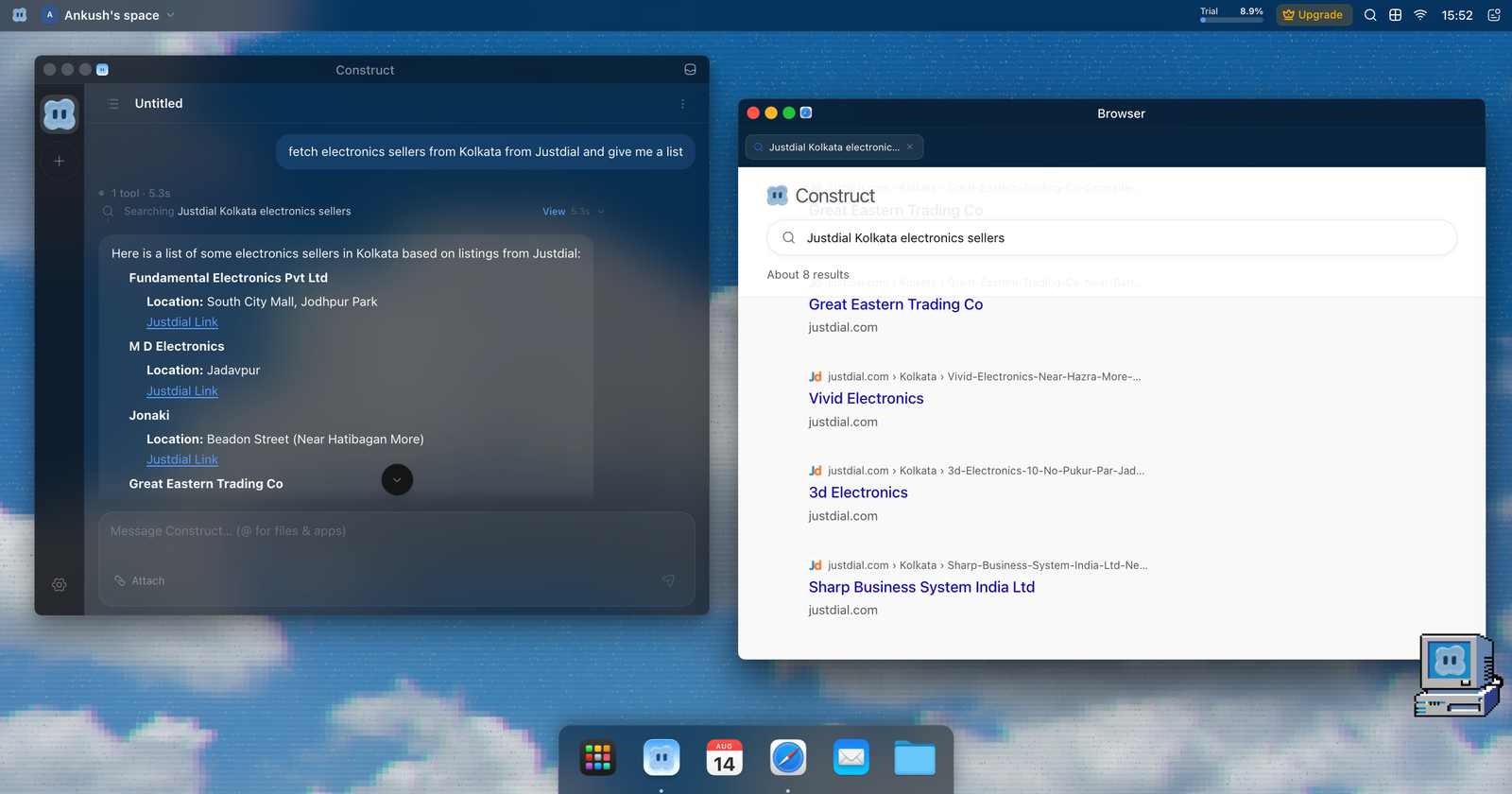
Construct uses Context.dev for non-interactive search tasks. An agent can form a query, retrieve current results, and continue working with the returned pages without waiting for a person to step into the loop.
The screenshot above shows that flow end to end. Construct searches for electronics sellers in Kolkata, Context.dev returns usable sources, and the agent presents a structured list while keeping the live results available in its browser.
Page understanding beyond text
Search results are only the first step. Construct also needs to crawl pages and understand what they contain so its agents can use the material in the next part of a task.
"We use Context for non-interactive search tasks in Construct, where its ability to crawl and understand web content is quite useful. We also like that it can OCR images on webpages, giving us better and more usable responses."
Image OCR expands what the agent can use. When important details live inside screenshots, scans, charts, or other page images, Construct can still bring that information into the response instead of treating the page as text alone.
Key benefits
- A working connector in minutes: Construct moved from the docs to a functioning service in one short implementation session.
- Reliable non-interactive search: agents can retrieve live web results and continue working without manual intervention.
- Search and crawling in one integration: the same connector finds sources, opens pages, and turns their contents into useful context.
- More complete page understanding: image OCR makes information embedded in webpage visuals available to the agent.
- No crawling stack to maintain: Construct avoided taking on a custom scraping pipeline alongside its core product.
The outcome
Construct replaced a fragmented provider search and a possible homegrown crawler with one dependable connector. Within minutes, Context.dev was powering non-interactive web search, page crawling, content understanding, and image OCR inside an autonomous agent workflow.
Building an agent that needs to work from the live web? Context.dev's Web Search API returns current results, while its crawling and extraction APIs turn the pages behind them into usable context.
P.S. Want an AI agent that can research, browse, and work from its own cloud computer? Meet Construct.